This evening I finally had a chance to read the report crafted by the Philadelphia Coalition Advocating for Public Schools (PCAPS) entitled, " The Philadelphia Community Education Plan" and I must say I am finally impressed at the level of detail coming from an opposition group to the School District's proposals as of late. If the Philadelphia Federation Teachers had a hand in orchestrating some of the report, I am happy to call myself a Union member today. This is not to say that I am in full agreement with everything proposed within the plan or that I am sold on all of its arguments, but I am excited to say there is another viable option on the table for Superintendent Hite and the School Reform Commission to analyze before making any major decisions. One major hesitation: I dislike how this report acts almost exclusively as a response to the plan put forth by the Boston Consulting Group (BCG) a few months ago. While I agree it is a good framework of comparison, the BCG plan seems not to be under total consideration at this point and I would have liked this plan to simply be a strong community effort to come up with a solution - not a "we are better than they are" type of thing. That being said, one of the most salient arguments I can see is shown in this one chart showing the money that could have been allocated to Philadelphia schools but instead was reallocated by the Corbett administration. As a math teacher I am keenly aware that charts can be manipulated to serve specific purposes, but this simple one is hard to argue with: if there were increased funding coming from the State, we would not be in such fiscal crisis, there would be more teachers, nurses, resources, etc.
In recent meetings I have heard the criticism that we (the tax-paying public) should not invest consistently in a failing enterprise or one that is fiscally irresponsible. The argument goes that even if we had the extra money, that would not improve the school system.
One of my favorite parts of this report is the demand of a true needs assessment across the school system. I think if people were to truly research what we need to do a good job in teaching, they would be surprised. Consistently I am baffled at the fact that I must scrounge for supplies like paper, pencils, books, computing equipment, etc. The fact that DonorsChoose recently partnered with Google to offer a discounted Chromebook is evidence that we have already gone overboard. Why should teachers have to organize and fundraise for computers themselves? These tools should be provided for them and they should be trained to use them.
I am sure I will have more to write as I re-read this document but I will leave you with a quote from one of the early superintendents of Philadelphia schools, James McAlister, who said, "a school system that is not costing a great deal these days is not worth a great deal." What he said in 1918 is still true almost 100 years later. I just wish we would put our money where our mouths are and give what we really need to educate our students.

On November 18, 2012 I put in an Internet filtering request to the School District tech people for a math games website devoted to Common Core Standards practicing. Apparently it was blocked because it has the word "games" in the website and title of the page. While I understand the limitation on online games in general, I would have hoped there would be a few teachers looking over the lists of websites being banned in order to provide input. I wanted this unblocked for a number of reasons, not the least of which is that the Keystone math test are being administered to the 10th and 11th grade students in January and I wanted to give them time to study for it. In follow-up to my request, I received the following in an email on December 14, 2012: The Internet Filtering Exception Request indicated above has been reviewed by your Principal as well as by the Instructional Technology Filtering Committee. Your request has been APPROVED.
Changes to the District's filtering system should occur within 10 days of the start of the month following the month in which the request was received for review.
If I am reading this correctly, then the Common Core gaming website I want unblocked in preparation for the administration of the Keystone on January 9-11 will only be available in January, even though I put the request in on November 18. To me, this is unacceptable. As a teacher trying to keep up on the most recent use of technology to encourage learning and growth, I need all the tools at my disposal as quickly as possible. If it will take 1.5 months for every website to be unblocked, why should I even bother trying? Recently, another website, billed as the Pinterest for education, Learn.ist has been growing quite quickly, yet remains blocked on the SDP network. One very easy solution to this would be to include teachers in the group responsible for vetting these sites - it might take some heat off the tech support staff and provide rationale for why certain sites are blocked or not.
As a proficient Internet user I sometimes get stumped when I discover useful tools that are blocked by the network within the School District of Philadelphia. Unfortunately, when trying to find something useful to share with our students, we teachers are often confronted with the large warning sign I'm showing, followed with a brief explanation and a method for requesting a review of the website in question. This system seems all well and good with the exception of two aspects: 1) In my opinion, there are a few websites that could (and should) be blocked for students but open for staff to use. For example, YouTube. I understand that we do not want our students spending valuable time surfing for silly videos, but YouTube is an amazing resource for teachers. News clips, short episodes, and more (including quadratic formula raps) are available online for free. As a professional, I find this mind-boggling. 2) It takes a long time to get a filtering change request accepted. Three weeks ago I submitted a request to remove the filter on a new Common Core Standards gaming website. This is a great resource to get kids used to using these sites and to practice basic concepts that will show up on standardized assessments (as much as I hate them) and learn new content. The response I received when I asked for follow up was: "The filtering committee has yet to come to a decision on your request. It is unclear how long it will be before a decision is made." This website will take all of five minutes for someone downtown to decide that it is okay; if it doesn't, we need a new filtering committee. This is another case where teachers' thoughts are not taken into consideration. There are plenty of sites that I would block from students (like Twitter, for example, which is unblocked for some reason). Yet there is a lot of clandestine activity when it comes to the network. We need things to be more open and honest in order to help get the students and teachers the resources they need.
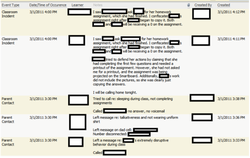
It seems that at around this time every year I post something regarding student anecdotes and documentation thereof on this blog. For the past three years I have been lucky enough to work with staff interested in utilizing technology to effectively help and change behavior that could potentially cause extremely negative outcomes for students. Even the School District of Philadelphia is attempting to rework their system, but I would argue the new Response to Intervention (RtII) system is too slow and too bulky that teachers won't use it. Instead, they should reach out to me and my colleagues who have experience using a (now) tried and true system called the Learner Log, a system in which all teachers can create and track student anecdotes for the purpose of positive interventions.
I first crafted a student anecdote system on Google Docs a few years ago when I was at West Philadelphia HS, only to realize the power of Microsoft SharePoint to make a database when I was transferred to School of the Future. Since then I brought the system to the Academy at Palumbo and have received only positive responses.
The basic idea is this: teacher's time is precious and student's time even more so. Whenever a teacher has a negative or positive interaction with a student, they can take 20 seconds of their day and input information onto the Learner Log. Other teachers can do the same so after a certain amount of time you have a record of various interactions with a student. If there is a pattern of disruption noticed or many teachers have tried to call home but to no avail, this system collates that information and allows you to learn more it.
When I first heard of RtII I was concerned that it would be too bulky and not user friendly - after three months of attempted uses, I think I am correct. I really wish the School District would pay more attention to what teachers are doing on the classroom-level and discuss with us how these systems work (or don't). If they did, maybe we would offer more streamlined approaches to these issues.
I find it very interesting that when someone writes a piece approving or supporting an organization it can be often ignored but when an organization is criticized, many people pay attention. First I want to apologize for misleading anyone: the Philadelphia Federation of Teachers has played an active role in the Philadelphia Coalition for Advancing Public Schools (PCAPS). They attend meetings and have used their voice to help influence policy and requests from that group. That being said, it is important to note that I had to be reminded of that fact by others, which harkens a different problem: public relations. The PFT should be a support network and resource for its 15,000 members and - to a certain extent - it is. But when it comes to providing specific suggestions from the headquarters at 1816 Chestnut Street, there is often little fanfare. I was recently pointed to the testimony Jerry Jordan gave at the City Council meeting last week and told that this was a good indication of what the Union is proposing. While I agree on many (if not all) of the points presented in this testimony, I find it hard to call it a true proposition. In the fifth paragraph, Jerry states, "To be clear—there are many specific things in the Boston Consulting Group’s plan that we disagree with. But the real problem with the plan is the process under which it was developed and presented to decision makers and residents of our city." While I agree completely with this statement, it still does not point out anything specific that the Union supports. The testimony continues to provide numerous examples of problems with the process and specific considerations that the PFT disagrees with. At the end of the piece we finally see two (mostly) concrete suggestions (emphasis added): - No system can thrive under the years of consistent disinvestment that our public schools have been subjected to. Our parents, teachers and students are doing all they can with limited resources. We need Harrisburg to take more ownership in the success of our schools by devoting the resources our district needs to be competitive with neighboring counties, who spend nearly twice as much per pupil, resulting in significantly higher student performance.
- We are calling for a school funding strategy that combines adequate levels of state, local and federal investments to ensure that our schools are providing the high quality academic resources, programs, materials and services to every child.
Now these suggestions I can completely get behind. I just wish the PFT would bring them up earlier and start advertising them to its membership (me) in a more conducive manner. If that happened, I think there would be more active meetings in schools across the District and more people attending general meetings.
Two weeks ago the president of the Philadelphia Federation of Teachers, Jerry Jordan, wrote a blog post denouncing the plan that the District has put forth to remove free busing for the Girard Avenue Music Program in order to fix some of their finances. He says, " The single-minded focus on saving money has done nothing but hurt our neighborhood schools and students." As a Union advocate and supporter of the AFT, I must unfortunately point out that this post does not offer any concrete solutions or steps that can be taken to avoid the dark situation it presents. While I am sure that the leadership in the Union is currently working on plans to advocate for my rights as a teacher and is trying very hard to improve support systems for people like me, it is difficult to get over the fact that this post (and others like it) seem like simple griping sessions instead of offerings of legitimate strategies. As I have mentioned before, I often do not feel like I know what my Union is doing for me whereas groups like the Philadelphia Coalition Advocating for Public Schools is crying to the hills about what they want.I understand that secrecy may have been necessary in the past on what Union plans existed but at this time my support is waning. I want to propose solutions (like reducing the required number of standardized tests, providing venues for teachers to educate each other instead of paying outside firms to do so, and more). And if you think no one is listening, just go to a School Reform Commission meeting and get your voice heard directly by those in charge.
|