As a teacher only 90 miles away from New York City I am particularly aware of major changes occurring within the Department of Education of NYC, specifically their recent publishing of 18,000 teachers' evaluation scores. I agree with many others out there that these data are so demoralizing and often untrue that they should have been kept internal. Promoters tell us that readers should take the information with a grain of salt in order to seek the truth; but in reality it will be used as a tool for parents and communities to attack teachers more and more.
While Secretary of Education Arne Duncan may extoll the freedom that the Race to the Top (RTTT) initiative provides to states to determine their own measures of evaluation in order to receive waivers on the No Child Left Behind act's insane demands, it is still approving (or not) the individual plans. In cases like New York, the RTTT funding hinged on the development of a new evaluation system that included a large percentage of a teacher's quality to standardized tests. If a plan does not have that, it will not be accepted. New York's money was almost rescinded until a new plan was developed.
As always, the arguments come down to how effective can a standardized test truly be at evaluating teacher quality. In theory an algorithm could be used that would measure the change in knowledge that a student has after being subject to an individual teacher for a few months.
While Secretary of Education Arne Duncan may extoll the freedom that the Race to the Top (RTTT) initiative provides to states to determine their own measures of evaluation in order to receive waivers on the No Child Left Behind act's insane demands, it is still approving (or not) the individual plans. In cases like New York, the RTTT funding hinged on the development of a new evaluation system that included a large percentage of a teacher's quality to standardized tests. If a plan does not have that, it will not be accepted. New York's money was almost rescinded until a new plan was developed.
As always, the arguments come down to how effective can a standardized test truly be at evaluating teacher quality. In theory an algorithm could be used that would measure the change in knowledge that a student has after being subject to an individual teacher for a few months.
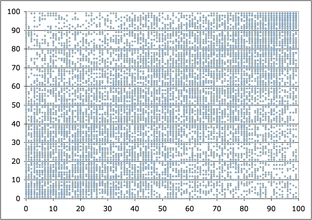
Graph credit: Gary Rubenstein's TFA Blog
In practice, these calculations are so difficult that they often have no correlation whatsoever. Gary Rubenstein, a TFA alum from Houston, has started analyzing the data to show how the model algorithm fails to predict high quality teachers year after year.
Other issues abound as well. In Florida, some teachers are evaluated based on test scores for subjects they do not teach.
Recently in the same state, Rick Roach, representative for District 3 on the Board of Education, took the Florida Comprehensive Assessment Test and analyzed his poor results. By his own admission the test does not focus on what it should.
So if all of this is true and known, what can we do? At this moment, it is important to remember what networks are available and what networks can be created in order to fight back against this movement. Examples like this school in North Carolina that has great success without emphasis on testing could become ubiquitous if only they were celebrated louder.
The key thing right now is to keep up-to-date on what is happening in the realm of teacher evaluation and how it will affect the future of our country. If you want to try out some standardized tests yourself, go for it. If you would like to read up on current education news, read a few of the articles linked in this post.
Be sure to do what I tell my students every day: maintain a critical eye and ask good questions.
Other issues abound as well. In Florida, some teachers are evaluated based on test scores for subjects they do not teach.
Recently in the same state, Rick Roach, representative for District 3 on the Board of Education, took the Florida Comprehensive Assessment Test and analyzed his poor results. By his own admission the test does not focus on what it should.
So if all of this is true and known, what can we do? At this moment, it is important to remember what networks are available and what networks can be created in order to fight back against this movement. Examples like this school in North Carolina that has great success without emphasis on testing could become ubiquitous if only they were celebrated louder.
The key thing right now is to keep up-to-date on what is happening in the realm of teacher evaluation and how it will affect the future of our country. If you want to try out some standardized tests yourself, go for it. If you would like to read up on current education news, read a few of the articles linked in this post.
Be sure to do what I tell my students every day: maintain a critical eye and ask good questions.

 RSS Feed
